Amavi Restaurant
The Challenge
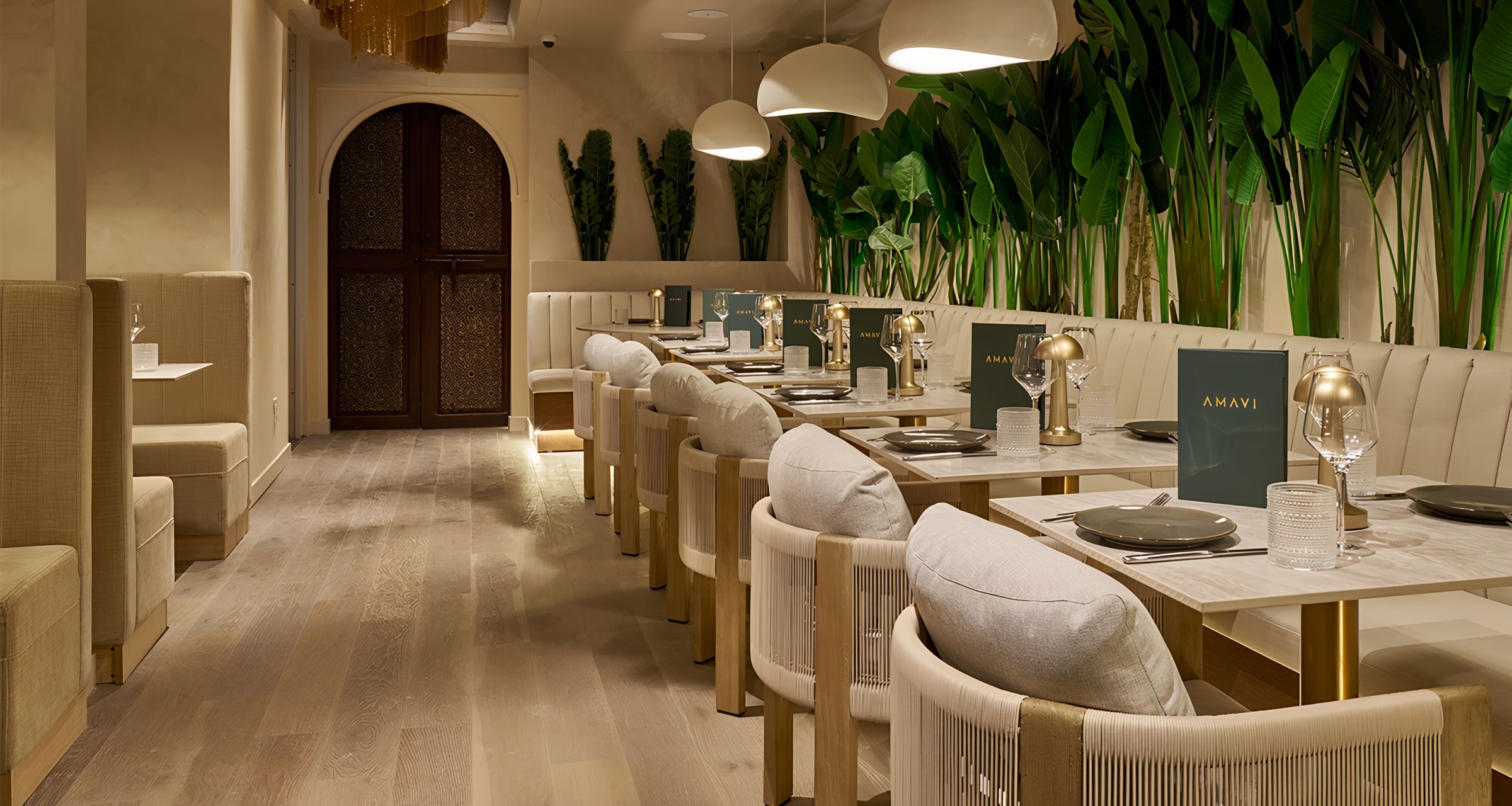
The interior's architectural identity arrived already declared: arched entry doors fitted with geometric metalwork grilles, heavily hand-troweled plaster on walls and columns, a warm layered palette that absorbs rather than reflects light. The millwork was required to read as continuous with that register, not applied over it. Every fabricated element had to carry the tonal weight of the architectural shell while meeting the durability demands of full-service restaurant operation.
Dining Floor
The banquette seating system runs as a continuous perimeter along one wall of the dining floor. Each unit was built with a recessed toe kick carrying integrated LED strip lighting, creating a visual separation between seating base and floor that makes the mass of the seating read as suspended rather than bearing. The effect opens the floor plane perceptually, expanding the apparent volume of the room without altering its physical dimensions. Built into the back of the run is a continuous planter box, fabricated as a permanent architectural element rather than a freestanding fixture, introducing biophilic material directly at the diner's peripheral sightline. Opposite the banquette, high-backed custom booths define the room's secondary boundary and its primary acoustic layer. Vertical channel-tufted upholstery on the booth panels provides sound absorption at the dining surface. Channel spacing was coordinated with table positions across the full run, producing a visual rhythm along the wall that registers as intentional rather than incidental.
Bar
The bar functions as the interior's operational anchor and the spatial hinge between the dining floor and the cocktail program. As the highest-traffic fabrication in the space, it sustains full-service volume across a restaurant day while presenting a finish level consistent with the surrounding architecture. Custom cabinetry at the bar and service points addresses the operational program while maintaining the surface standard of the guest-facing millwork, ensuring that functional elements don't interrupt the interior's material continuity.
VIP Room
The VIP room sits within the same footprint as the main floor but operates as a distinct spatial environment. Enclosed by floor-to-ceiling millwork panels in oiled white oak, the room seats twelve across a custom banquette and loose seating arrangement. Arched openings echo the restaurant's entry language, while upholstered wall panels bring the acoustic character of the booths into a fully enclosed setting. The joinery detail at the panel seams was taken from the bar millwork, tying the two spaces together without dissolving the VIP room's sense of enclosure and privacy.
Outcome
The seating system across the main floor was fabricated and installed as a coordinated assembly, with consistent upholstery profile, base geometry, and finish treatment across both booths and banquettes establishing a single material language across the floor plan. That coherence is structural: it holds the interior's tonal register across the full service area without relying on lighting or decoration to unify what the fabrication didn't.
When Agsia Studio designed Amavi's second location in Midtown Miami, a 4,000-square-foot space anchored by a 33-foot natural stone bar that opened in July 2025, the New York interior served as the primary spatial and material reference. That the fabrication identity translated clearly enough to anchor a second market is a measure of how the original millwork was specified and built.